
Practical Field Safety for Law Enforcement & Public-Sector Professionals
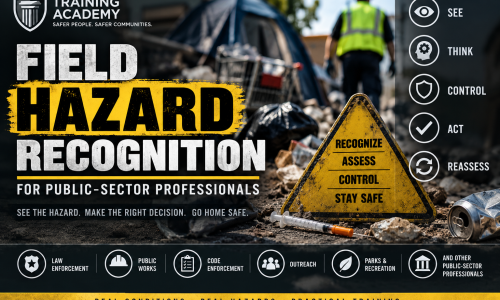
Hazard Recognition Training
Hazard recognition training helps public-sector professionals identify changing conditions, recognize potential hazards, and make safer decisions before an exposure, injury, or confrontation occurs.
This course is designed specifically for professionals whose work takes them outside controlled office environments and into real-world field conditions. Rather than focusing on a single hazard, participants learn to evaluate the entire scene and recognize how multiple hazards can develop or interact at the same time.
Public-sector employees routinely work in uncontrolled and unpredictable environments. A routine service call, outreach contact, property inspection, roadside assignment, cleanup request, welfare check, or field visit can expose employees to hazards that were not apparent when the assignment began.
Hazard recognition training teaches employees to recognize changing conditions, identify potential hazards, and make safer decisions before an exposure, injury, or confrontation occurs.
Designed for law enforcement, outreach and human-services personnel, public works, parks and recreation, code enforcement, inspectors, facilities and maintenance personnel, and other city, county, and public-agency employees, this course uses photographs, videos, real-world examples, and interactive scenarios drawn from actual field environments.
Participants learn to recognize and assess hazards involving:
- People and behavior — escalating situations, unpredictable individuals, bystanders, personal space, positioning, exit routes, and when to disengage
- Traffic and vehicles — moving traffic, roadside work, intersections, visibility, vehicle positioning, and heavy equipment
- Animals and pests — dogs, rodents, insects, animal waste, bites, scratches, and unexpected animal encounters
- Blood, bodily fluids and biohazards — blood and OPIM, human waste, decomposition, contaminated materials, and cross-contamination
- Sharps and drug-related hazards — discarded needles, hidden sharps, drug paraphernalia, powders, and unknown substances
- Environmental and structural hazards — unstable surfaces, broken glass, electrical hazards, poor lighting, extreme weather, fire hazards, debris, terrain, and unsafe structures
- PPE and contamination control — selecting appropriate precautions, understanding the limitations of PPE, preventing contamination from spreading, and recognizing when specialized assistance is needed
Throughout the course, participants use a practical five-step field approach:
RECOGNIZE → ASSESS → PROTECT → ISOLATE → REPORT
The goal is not to turn employees into remediation, hazardous-materials, or emergency-response specialists. The goal is to develop the ability to read the entire scene, recognize hazards before interacting with them, understand personal and organizational limitations, and know when conditions require the employee to stop, withdraw, isolate the area, or request additional resources.
Real-world “What Do You See?” exercises challenge participants to examine complex field scenes where multiple hazards may exist simultaneously. Learners identify what they see, consider what they may be missing, make a field decision, and then compare their assessment with the hazards and recommended actions revealed in the course.
Curriculum
- 9 Sections
- 37 Lessons
- Lifetime
- Section 1 — Situational Awareness: Read the Scene Before You EnterField safety begins before an employee enters a property, approaches a person, steps into traffic, or begins an assigned task. This section introduces a practical approach to situational awareness and teaches participants to evaluate the entire environment rather than focusing only on the reason they were dispatched or assigned to the location. Participants will learn to conduct an initial scene assessment, recognize changing conditions, identify entry and exit routes, avoid tunnel vision, and continuously reassess their surroundings while working in uncontrolled environments.5
- Section 2 — The Human Element: Behavior, Conflict & Personal SafetyPeople can be one of the most unpredictable elements of a field assignment. Employees may encounter individuals who are angry, frightened, impaired, emotionally distressed, confused, protective of their property, or simply unwilling to cooperate. This section focuses on recognizing behavioral warning signs, maintaining awareness of people in and around the work area, preserving appropriate distance and positioning, identifying potential escape routes, and recognizing when conditions are escalating. Participants will also learn the importance of disengaging and requesting assistance when a situation exceeds their role, training, or ability to safely continue.4
- Section 3 — Traffic, Vehicles & Roadside HazardsTraffic and vehicle movement can present immediate and potentially severe hazards during field operations. Employees working near streets, intersections, parking lots, road shoulders, damaged vehicles, heavy equipment, or active work zones must remain aware of hazards beyond the task directly in front of them. This section addresses moving traffic, distracted drivers, limited visibility, vehicle positioning, blind areas, intersections, roadside work, heavy equipment, and the danger of becoming so focused on an assignment that surrounding vehicle hazards are overlooked.4
- Section 4 — Animals, Insects & Biological Environmental HazardsAnimals and pests can create unexpected hazards in residences, encampments, vehicles, abandoned properties, parks, alleys, outdoor work areas, and other field environments. This section teaches participants to recognize potential hazards involving dogs and other animals, rodents, insects, bites and scratches, animal waste, dead animals, nesting or protective behavior, and environments with evidence of significant pest activity. Participants will learn to consider animal hazards before entering an area and avoid assuming that an apparently calm or familiar animal is safe to approach.4
- Section 5 — Blood, Bodily Fluids, Sharps & BiohazardsPublic-sector employees may encounter blood, bodily fluids, human waste, discarded needles, contaminated materials, decomposition, and other biological hazards during routine field assignments. This section focuses on recognizing potential biohazards, understanding common routes of exposure, identifying visible and concealed sharps hazards, preventing cross-contamination, and determining when a condition requires additional precautions or specialized remediation. The objective is hazard recognition and safer decision-making—not training participants to perform professional biohazard remediation.5
- Section 6 — Drugs, Chemicals & Unknown SubstancesField employees may encounter drug paraphernalia, powders, liquids, chemical containers, strong odors, discarded containers, illegal dumping, or other substances that cannot be safely identified by appearance alone. This section teaches participants to recognize indicators of potential chemical and drug-related hazards without unnecessarily touching, smelling, disturbing, testing, or attempting to identify unknown substances. Participants will learn the importance of maintaining distance, controlling the immediate area, recognizing the limits of their training and PPE, and requesting appropriate specialized assistance.5
- Section 7 — Structural, Physical & Environmental HazardsNot every serious field hazard is biological or chemical. Unsafe structures, damaged flooring, broken glass, electrical hazards, poor lighting, fire hazards, unstable debris, extreme temperatures, uneven terrain, standing water, and other physical conditions can cause serious injuries. This section teaches participants to look beyond the obvious reason for an assignment and evaluate the physical environment before and during their work. Particular attention is given to hazards that may change as employees move through a property or begin disturbing materials.5
- Section 8 — PPE, Contamination Control & Knowing When to StopPersonal protective equipment is an important part of field safety, but PPE does not eliminate hazards or make an unsafe environment safe. This section focuses on selecting precautions appropriate to the observed hazard, understanding the limitations of PPE, maintaining separation between clean and contaminated items, and preventing contamination from spreading to phones, radios, vehicles, tools, offices, coworkers, or other locations. Participants will also learn one of the most important field-safety skills: recognizing when conditions exceed their training, equipment, authority, or ability to safely continue.5
- Section 9 — What Do You See? Real-World Field ScenariosField environments rarely present hazards one at a time. An employee may simultaneously encounter traffic, people, animals, sharps, biological contamination, unstable debris, unknown substances, poor lighting, and limited escape routes. This section brings together the principles taught throughout the course using realistic “What Do You See?” exercises. Participants will examine photographs, videos, and field scenarios before hazards are identified for them. They will be challenged to recognize both obvious and less apparent hazards, determine what additional information they need, decide whether the assignment can safely continue, and identify when additional resources should be requested. The objective is to develop a habit of reading the entire scene rather than focusing only on the assigned task.9
- 9.1Lesson 30: What Do You See? — Roadside & Vehicle Scene
- 9.2Lesson 31: What Do You See? — Encampment
- 9.3Lesson 32: What Do You See? — Residence or Hoarded Property
- 9.4Lesson 33: What Do You See? — Park, Alley or Public Space
- 9.5Lesson 34: What Do You See? — Illegal Dumping & Debris
- 9.6Lesson 35: What Do You See? — Outreach or Public Contact
- 9.7Lesson 36: What Do You See? — The Complex Scene
- 9.8Lesson 37: Final Field Hazard Review
- 9.9Final Assessment: Field Hazard Recognition for Public-Sector Professionals20 Questions
Instructor




Leave a Reply